
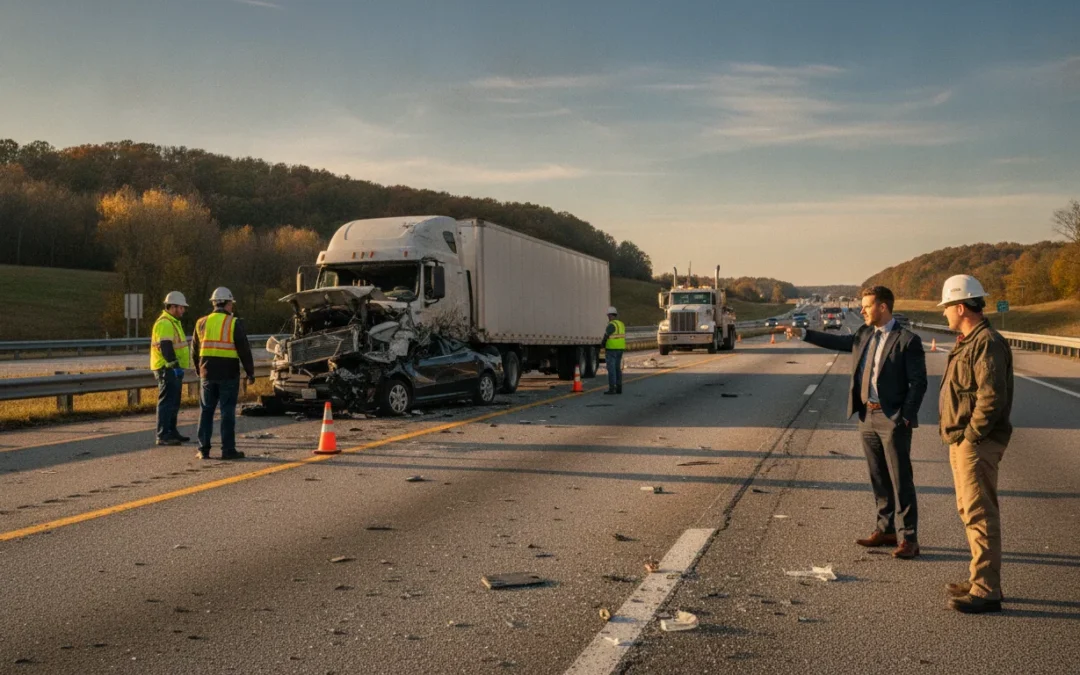
A truck crash can look like an ordinary collision at the scene, but the claim may require a wider investigation. The people and companies connected to the truck, the crash circumstances, medical treatment, police reports, and insurer communications can all matter when the facts are reviewed.
A kentucky truck accident attorney may examine more than vehicle damage and driver statements, including commercial records, available crash information, and evidence involving other parties. The available evidence does not decide a claim by itself, but it can help clarify what happened and which questions need careful attention.
Understanding why these claims can involve more moving parts is a useful first step. It also shows why gathering the right information early can matter as the investigation develops.
Why Truck Accident Claims Can Be More Complex in Kentucky
A collision involving a commercial truck may require more than comparing vehicle damage and reviewing a standard crash report. The investigation can involve the circumstances of the crash, the driver’s actions, the companies connected to the vehicle, insurance communications, and the injuries that followed. That does not determine who is responsible. It means the claim deserves a careful review before conclusions are reached.
| Investigation question. | Ordinary car crash. | Truck crash. |
|---|---|---|
| Who may be connected? | Often the drivers and vehicle owners. | May also include a carrier, broker, owner, or commercial insurer. |
| What records may matter? | Crash report, photos, medical records, and insurance communications. | Those records plus commercial identity, inspection, or safety records. |
| What needs to be clarified? | How the collision happened and who may be responsible. | How the collision happened, who may be involved, and which business records fit the facts. |
Commercial details can matter
Truck claims may involve information that is not present in an ordinary two-car collision. The available facts could include records identifying a carrier, information about the vehicle’s business use, and documents or communications maintained by people or companies connected with the trip. Which records matter depends on the specific crash. A Kentucky truck accident attorney can help identify the questions that need answers without assuming the outcome.
One crash can raise several investigation questions
A focused review may examine what happened before, during, and after the impact. It may also consider the accident scene, police reports, medical treatment, fault evidence, and communications with insurers. These pieces need to be understood together. A statement from an insurer, for example, should be considered alongside the available crash and injury information rather than viewed in isolation.
Personal attention can help organize the facts
Rick Hessig is identified by the firm as both an attorney and a Licensed Professional Private Investigator. The firm’s service description includes investigating accident circumstances, negotiating with insurers, and pursuing litigation when necessary. That combination supports a hands-on approach to developing the facts of a claim. For someone injured in Louisville or elsewhere in Kentucky, it can also provide a clear place to start when the process feels unfamiliar. Learning about preserving evidence after a crash may help you organize useful information while your situation is being evaluated.
How a Kentucky Truck Accident Attorney Investigates Commercial Records
A commercial truck crash can leave questions about the company operating the vehicle, the carrier connected to the trip, and the identities attached to the truck. Public records can help organize that investigation. They do not, by themselves, prove that a particular person or company caused a collision, and they cannot guarantee that an injured person has a claim.
Starting with the carrier’s identity
The Federal Motor Carrier Safety Administration, or FMCSA, makes regulated-entity census and safety-performance information available to the public at no charge. Its data includes records for entities with a USDOT Number, operating-authority information, safety measurement data, and certain out-of-service orders. Each entity record has a unique USDOT Number, which can help an investigator distinguish companies with similar names or connect a vehicle and carrier to the right public file.
The company census file includes active, pending, and inactive entities. That status is useful context, but it is not a final answer about responsibility. An investigator still has to compare the public record with the crash report, vehicle information, insurance communications, witness accounts, and other evidence from the specific collision.
Reviewing available safety and inspection data
FMCSA’s USDOT-number datasets include company census, crash, and inspection files. Those categories may point to records worth examining more closely, such as prior inspections or reported crashes associated with an entity. The agency also provides data dictionaries that explain file definitions and data structures. Reading those definitions matters because a database entry can be misunderstood when it is separated from its field name, date, or reporting context.
The FMCSA data page notes that its USDOT-number datasets are generated from a database that is 24 hours old and updated daily. That timing makes the information a research resource, not a substitute for confirming facts through case-specific documents and people with direct knowledge.
Following related business records
Some for-hire interstate carriers, brokers, freight forwarders, and specialized carriers may have operating-authority numbers, often called MC numbers. Checking those records can help identify additional entities or lines of inquiry. It does not establish that every listed business is legally responsible for a crash.
A careful investigation uses public FMCSA information as one part of a larger evidence review. The goal is to understand who may be connected to the truck and what records should be requested or examined next, while keeping conclusions tied to the facts of the individual case. See the FMCSA data dissemination program for the agency’s descriptions of these public datasets.
Who May Be Involved in a Kentucky Truck Accident Claim?
A commercial truck crash may involve more than the person behind the wheel. The driver may be part of the claim, but the trucking company, a vehicle owner, a freight broker, an insurer, or another business connected to the trip may also need to be identified. That does not mean every possible party is responsible. It means the facts should be examined before anyone reaches a conclusion about liability.
The truck driver
The driver’s actions and account of the collision may be important parts of the investigation. A claim review may consider what happened immediately before impact, the roadway and traffic conditions, statements from witnesses, and the available crash documentation. Those facts can help clarify the sequence of events without assuming the driver’s role in advance.
The carrier, owner, or broker
The carrier operating the truck may be different from the legal owner of the tractor or trailer. A broker or another company may have arranged transportation. Depending on the facts, each business relationship may raise different questions about who was involved in the shipment and whose records or insurance information should be reviewed. Some for-hire interstate carriers and brokers may have FMCSA operating-authority numbers, often called MC numbers, but an identifier by itself does not decide who is responsible for a crash. FMCSA explains that some carriers, brokers, freight forwarders, and specialized carriers may have operating authority numbers.
Insurers and other involved parties
One or more insurers may communicate with an injured person after the crash. Preserving those communications can matter while the accident circumstances, injuries, medical treatment, police reports, and fault evidence are reviewed. Rick Hessig Law describes its process as investigating accident circumstances, negotiating with insurers, and pursuing litigation when necessary. A careful review can help identify which parties and records are relevant to the particular claim.
For a related example of evaluating the evidence in a vehicle collision, read how crash evidence can show fault. The same basic principle applies here: the parties involved and the significance of the evidence depend on what the investigation shows.
What Evidence Should You Preserve After a Truck Crash?
After a truck crash, useful information can come from the roadway, the vehicles, medical records, police reports, and communications with insurers. Start by protecting your health and safety. Seek medical attention immediately for your injuries. Then preserve what you can without putting yourself back in danger or interfering with an investigation.
- Protect your health and move to a safe place if you can.
- Document the scene and gather witness information only when it is safe.
- Save medical records, police information, photographs, and insurer communications.
- Request guidance before making important statements or claim decisions.
Document the crash scene when it is safe
Take photographs or video of the vehicles, visible damage, the roadway, traffic controls, weather conditions, and any debris or skid marks that remain. Capture wide views as well as close-ups. If you cannot document the scene yourself, ask a trusted person to help. Write down the date, approximate time, location, direction of travel, and what you remember while those details are fresh.
Collect contact information for witnesses if they are willing to provide it. Keep the responding agency information and request a copy of the police report when it becomes available. These materials may help show what happened, but no single photograph, report, or statement automatically establishes fault.
Keep records about injuries and treatment
Save discharge instructions, bills, prescriptions, test results, appointment details, and notes about symptoms or limitations. Follow your medical provider’s instructions and keep a simple record of how the injuries affect work, household tasks, sleep, and daily activities. Do not guess at a diagnosis or minimize symptoms when speaking with a provider.
A crash evaluation may consider injuries and medical treatment alongside accident circumstances, police reports, fault evidence, and communications with insurers. Store these records in one secure folder. Review these steps to take after a wreck for a broader post-crash checklist.
Preserve communications and commercial details
Save every letter, email, text message, claim number, recorded-statement request, and payment offer from an insurer. Avoid deleting messages or changing photographs. Do not speculate about fault or provide a recorded statement before you understand what is being requested.
Write down the truck’s company name, USDOT number, license plate, trailer information, and any visible identifying marks if you have them. The Federal Motor Carrier Safety Administration’s crash statistics tool includes crash, driver, and environment information and allows users to select state crash records. It is one public research source, not a substitute for reviewing the complete evidence in an individual case. You can also read more about preserving evidence after a crash.
When Should You Speak With a Kentucky Truck Accident Attorney?
You do not have to wait until you understand every detail of a truck crash before asking for legal guidance. A conversation may be useful when your injuries are significant, the facts are disputed, or an insurance company is asking you to provide a statement or accept a quick payment. Speaking with an attorney does not promise representation, a settlement, or any particular result. It gives you a chance to understand what information may matter and what options may be available.
Consider talking with an attorney when the facts are unclear
Truck crashes can raise questions about the driver, the commercial carrier, the vehicle, the road, and the circumstances leading up to the collision. You may want help reviewing the accident circumstances, police reports, medical treatment, fault evidence, and communications with insurers. Those are among the subjects that may be considered during a crash claim evaluation.
The Federal Motor Carrier Safety Administration explains that its crash statistics are used to identify safety trends and factors associated with crashes. Its crash tool includes crash, driver, and environment information and allows users to select state records. That information can provide context for research, but a public data entry does not by itself decide what happened in your individual crash or who may be legally responsible.
Get guidance before making important claim decisions
Early advice may be especially helpful if you have ongoing treatment, missed work, serious vehicle damage, or multiple insurance companies contacting you. Keep copies of records and messages, follow your medical providers’ instructions, and avoid guessing about facts you do not remember. You can also review these questions for a Kentucky accident attorney before a conversation.
Choose a conversation that fits your circumstances
Rick Hessig Law describes its work as investigating accident circumstances, negotiating with insurers, and pursuing litigation when necessary. Rick Hessig is identified as both an attorney and a Licensed Professional Private Investigator. A case evaluation is an opportunity to share what happened and ask focused questions, not a guarantee that the firm will accept the matter or that the claim will succeed.
How Fees and a Case Evaluation Work
After a truck crash, you may be worried about medical bills, missed work, and the cost of getting legal guidance. Rick Hessig Law offers a free, no-obligation case evaluation for people in Louisville, Kentucky, and Southern Indiana. The purpose is to learn what happened, understand your concerns, and discuss whether the firm may be able to help. An evaluation does not promise representation or a particular result.
What to expect during the evaluation
A careful review may cover the crash circumstances, your injuries and medical treatment, possible fault issues, the police report, and communications with insurers. Bring or describe anything you have available, such as the incident report, photographs, medical information, insurance correspondence, and contact details for witnesses. You can also prepare for a case evaluation by writing down your questions and a clear timeline of what occurred.
How the fee arrangement is explained
When appropriate, the firm uses the approved phrase No Fee Unless You Win to describe its contingency-fee approach. You are entitled to understand the proposed arrangement before deciding what to do next. The firm should explain what the agreement covers and answer questions in plain language. No specific contingency percentage is stated here because the terms depend on the agreement and circumstances of an individual matter.
Important case-cost disclosure
No upfront attorney fee does not necessarily mean that every expense is free. Under the required Kentucky Bar disclosure, case and court costs may be the client’s responsibility. Ask what costs may arise, how they are handled, and what the written agreement says. To request the evaluation, use the free case evaluation form or call the KY Injury Hotline at 502-777-1111.
Frequently Asked Questions
When should I hire a truck accident lawyer?
Consider speaking with a Kentucky truck accident attorney as soon as you can, especially if you were injured, multiple companies or people may be involved, or an insurer is asking for a statement. An early review can help organize medical records, police reports, crash details, and communications with insurers before important questions become harder to answer.
How much are most truck accident settlements?
There is no reliable standard settlement amount without reviewing the specific facts. The evaluation may consider the injuries, medical treatment, evidence of fault, available insurance, and the roles of the driver, carrier, owner, broker, or other parties. A careful review can explain what is known without promising a result or inventing a figure.
Can I sue the truck driver after a crash?
Possibly, but whether a claim may be brought against a driver depends on the facts and applicable law. Other parties may also require investigation, including a trucking company, vehicle owner, broker, or insurer. The driver’s involvement alone does not establish liability, so the crash evidence and individual roles must be evaluated.
Can I afford a truck accident lawyer?
Rick Hessig Law offers a free, no-obligation case evaluation. The firm describes its injury-fee arrangement as No Fee Unless You Win, but case and court costs may be the client’s responsibility under the Kentucky Bar disclosure. Ask what fees and costs may apply before deciding how to proceed.
Get started with a Kentucky truck accident evaluation
Commercial records, multiple parties, and specialized evidence can make a truck accident claim difficult to assess on your own. A focused conversation can help you understand what information may matter and what next steps fit your situation. Request a free, no-obligation case evaluation or call the KY Injury Hotline at 502-777-1111. Car Wreck? Call Rick!