
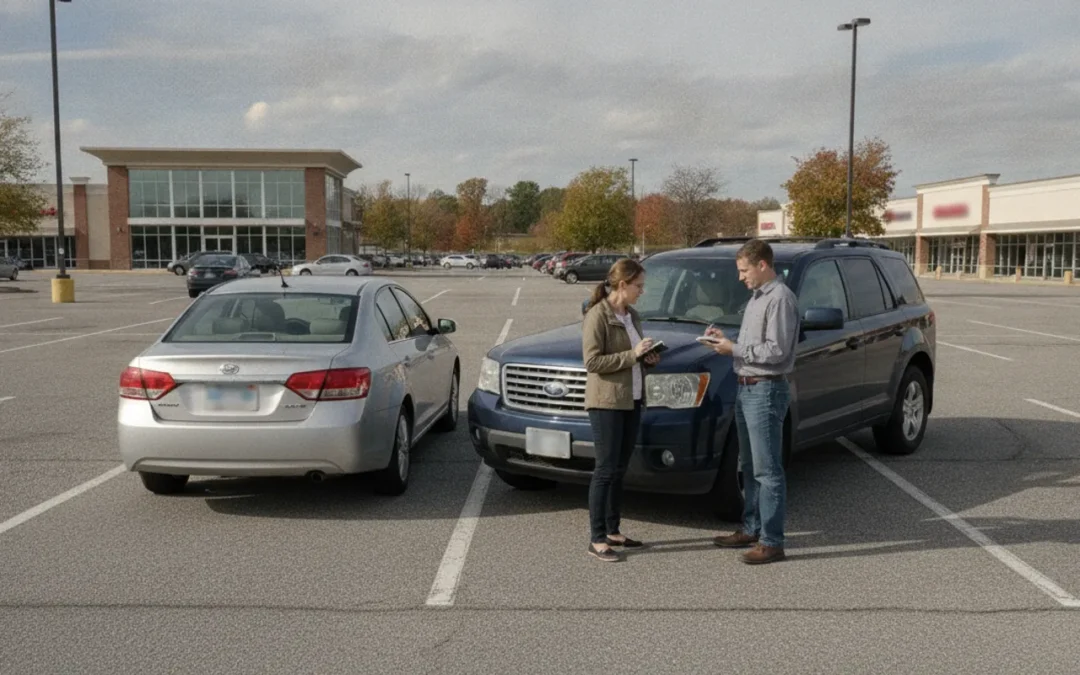
If you were hurt in a parking lot crash, you may be wondering whether a parking lot accident attorney can help identify who may be responsible. The answer depends on how the collision happened, what each person did, and what evidence is available. If you are in Louisville or Southern Indiana, you can contact Rick Hessig Law to discuss what happened and ask about a free case evaluation.
Contact Rick Hessig Law about your crash
Who may be responsible for a parking lot accident?
Responsibility usually turns on the actions that led to the crash, not simply on the fact that it happened in a parking lot. A driver who backs out without checking, cuts through a parking space, or fails to watch for people walking may have contributed to a collision. Another driver, a property owner, a business, or a maintenance company may also warrant closer review if their conduct or the condition of the lot played a role.
Those are possibilities to investigate, not automatic conclusions. A driver is not necessarily at fault just because their car was moving or because the other vehicle was already in an aisle. The angle of impact, sight lines, signs and markings, lighting, witness accounts, and available video can all matter. A Kentucky shared-fault claim can raise questions about how each person’s actions affected the crash, so avoid assuming the answer based on one detail.
Why can parking lot crashes be hard to sort out?
Parking lots bring cars, pedestrians, loading activity, and tight turns into a small space. Drivers may be looking for an open stall, reversing out of a space, or crossing an aisle at the same time. Painted arrows and stop signs can help explain traffic flow, but markings may be faded, blocked, or absent. A lot may also have several entrances or lanes that make it harder to reconstruct what happened.
There may not be a clear independent witness. Drivers can remember the same moment differently, and a minor-looking impact can still leave someone injured. A collision between two moving vehicles may involve different questions than a car striking a pedestrian or a vehicle hitting a stationary object. Starting with the specific sequence of events is more useful than guessing who is to blame.
A parking lot is not automatically outside the scope of an injury claim just because it is private property. At the same time, a property owner is not automatically responsible whenever a crash occurs on its lot. To assess whether a property condition matters, the facts would need to show what hazard existed, who controlled or maintained the area, and how that condition may have contributed.
What should you do after a parking lot crash?
First, check whether anyone needs urgent help. Seek medical attention immediately for your injuries. If you can safely do so, move out of active traffic and call for emergency assistance when needed. Do not put yourself at risk to take pictures or gather information.
When it is safe, exchange names and contact and insurance information with the other driver. Get the make, model, color, and plate number of the vehicles. Note the time and exact part of the lot where the crash occurred. If someone saw the collision, ask for their name and contact information. Keep your account factual and avoid arguing or guessing about fault at the scene.
Call local law enforcement when appropriate, especially if someone is hurt, the scene is unsafe, or you need help documenting what happened. Whether an officer responds or prepares a report can depend on the circumstances. Do not assume that an incident report alone will decide responsibility. The California Department of Insurance’s general after-accident guidance discusses practical next steps, but it is not a statement of Kentucky law.
For a broader checklist of immediate steps, see what to do after a car wreck and this car accident checklist. The details that matter in a parking lot can be easy to overlook, so write down what you remember as soon as you can.
How might different parking lot crashes be evaluated?
The same parking lot can produce very different liability questions. Consider the movement each person was making and what they could reasonably see. These examples are not conclusions about any particular crash; they show why a closer review of the details can matter.
- Two vehicles meet in an aisle: The investigation may look at where each vehicle entered the aisle, whether either was turning or crossing, the direction of travel, and the point of impact. A photo of the final positions can help, but it may not show the whole sequence.
- A vehicle reverses from a parking space: The positions of nearby vehicles, landscaping, carts, or other obstacles may have limited visibility. Video or a witness may help explain whether either driver had time to notice the other.
- A pedestrian is struck: Investigators may need to establish where the person was walking, whether there was a designated walkway, how the vehicle approached, and whether lighting or obstructions affected what the driver could see.
- A surface or maintenance issue is raised: It helps to identify the specific condition and document it promptly. The question is not merely whether the lot could be improved, but whether that condition contributed to the incident and who was responsible for it.
These are different fact patterns, and one detail rarely answers every question. For instance, a vehicle backing out does not automatically establish all responsibility, just as a pedestrian’s presence in a driving aisle does not, by itself, resolve a claim. The surrounding evidence and each person’s conduct need to be considered together.
What evidence can help explain what happened?
Try to preserve information that shows the scene and the events before and after impact. Take photos or video only when it is safe. Capture the vehicles from several angles, damage, debris, skid or scrape marks, parking spaces, aisle directions, signs, lighting, and any nearby obstruction that affected visibility. A wide view can show where the vehicles were in relation to one another; close views can document damage.
Parking lot surveillance footage may be overwritten or retained for a limited period. If a store, property manager, or nearby business may have cameras, note their location and promptly ask that relevant footage be preserved. Do not assume a business will keep a recording indefinitely or that it will automatically be shared. An attorney can help make an appropriate preservation request and assess what else may be useful.
Keep copies of the incident or police report if one is made, medical records and bills, repair estimates, receipts for related expenses, and messages from insurers. Write down symptoms and how they affect ordinary activities, without exaggerating or trying to diagnose yourself. If you have already given a statement, keep a record of when it happened and who contacted you. For more on care and documentation, see what to do after a car accident injury in Kentucky.
Evidence depends on the type of crash. The table below lists examples of information that may help investigate different situations; it does not decide fault by itself.
| Parking lot situation | Evidence to look for | Why it may matter |
|---|---|---|
| Two vehicles collide in an aisle | Vehicle positions, damage patterns, aisle direction signs, witness accounts, nearby camera footage | May help clarify each vehicle’s path and the sequence of impact |
| A vehicle backs out of a stall | Photos of the stall and aisle, sight-line obstructions, vehicle damage, video or witnesses | May help show visibility and what each driver could see before moving |
| A car hits a pedestrian | Crosswalks or walkways, lighting, clothing and visibility conditions, witness details, medical records | May help establish where the person was walking and how the driver approached |
| A lot condition may have contributed | Photos of a pothole, debris, poor lighting, blocked view, or missing markings; maintenance or complaint records if available | May help determine whether a condition contributed and who controlled or maintained it |
Can a property owner or business be responsible?
Possibly, but a difficult or inconvenient lot does not by itself establish a claim against its owner. A closer look may be warranted if a specific condition—such as a damaged surface, an obstructed view, or a lighting problem—played a meaningful part in the collision. The key questions include whether the condition created a foreseeable risk, who was responsible for addressing it, and whether reasonable steps were taken.
Responsibility may be divided among more than one person or entity, depending on the facts. For example, a driver’s choices and a physical condition could both be relevant. The available records, maintenance history, photographs, and witness accounts may help clarify whether the property issue was more than just background context. Do not assume that the business where the crash occurred owned or maintained every part of the lot.
For a collision involving a delivery vehicle or another commercial vehicle, the investigation may involve additional parties and records. That does not mean every parking lot crash with a work vehicle is a commercial liability case. The facts matter. Rick Hessig Law’s guide to evidence in a Kentucky truck accident claim covers a separate type of crash and should not be treated as a substitute for evaluating the specific parking lot incident.
How do insurance claims work after a parking lot accident?
Which insurer may be involved depends on the people and vehicles involved, the available coverage, and how the crash occurred. You may need to notify your own insurer even if you believe another driver caused the collision. Keep communications organized, and make a note of claim numbers, dates, and the names of people you speak with.
An insurer may ask for a recorded statement, photos, or other information. You can ask what the request is for and take time to understand it before responding. Be accurate. Do not speculate about speed, distance, or fault if you do not know. Avoid signing a release or agreeing to a final settlement before you understand what it covers and how your injuries are developing. This overview of what to expect from a car accident settlement explains why the details of a claim can matter.
If the other driver has no insurance, or their available coverage may not cover the loss, your own policy could be relevant. Coverage terms vary, so review the policy rather than assume what it provides. Rick Hessig Law explains some related questions in its pages about being hit by an uninsured driver and underinsured driver claims in Kentucky.
For more on communicating with an insurer, read how to handle an auto insurance claim after a Kentucky crash. Each policy and claim is different, so a general article cannot determine which coverage applies to you.
When should you speak with a parking lot accident attorney?
You may want to speak with an attorney if you were injured, the other driver disputes what happened, multiple people or businesses may have contributed, or an insurer is asking you to make decisions before you understand your options. It can also be useful to ask for guidance when important video or other evidence may be at risk of disappearing.
A lawyer can review the facts, help identify possible sources of evidence, communicate with insurers, and explain potential next steps. No attorney can promise a particular result just from an initial description of the crash. Bring any photos, report information, insurance correspondence, and medical records you already have. You do not need to have every document assembled before asking for a case evaluation.
Rick Hessig is a Kentucky attorney and Licensed Professional Private Investigator. Rick Hessig Law focuses on car-accident victims in Louisville and the Kentuckiana area, including Southern Indiana. The firm’s approach includes personal attorney involvement and investigation-backed case development. If you want to compare questions to ask before choosing counsel, you can also read this guide to selecting a car accident lawyer.
Rick Hessig Law offers a free, no-obligation case evaluation. The firm uses a contingency-fee model described as “No Fee Unless You Win,” with no upfront attorney fee. In accordance with KBA regulations, we must inform you that case and court costs may be the responsibility of the client. Ask questions about the fee agreement and costs before deciding whether to proceed.
Request a free case evaluation
Frequently asked questions
Does a parking lot accident automatically make one driver at fault?
No. The location alone does not decide responsibility. The drivers’ actions, the direction each vehicle was traveling, visibility, and other evidence can all matter.
Can I make a claim if the crash happened on private property?
A crash on private property may still raise injury and insurance questions. Whether a claim is available depends on the facts, the parties involved, and applicable coverage and law. A property owner is not automatically responsible just because the crash happened on its lot.
What if there is no police report?
Not having a report does not by itself answer who was responsible or whether you may have a claim. Preserve your own notes, photos, witness details, insurer communications, and medical records. Other evidence may help explain the collision.
Should I accept an insurer’s first offer?
Do not decide based only on the fact that an offer was made. Consider what it covers, whether your injuries and related losses are understood, and whether signing would end the claim. You can ask an attorney to review your questions before you respond.
Talk through your next step
A parking lot crash can leave you with questions about fault, evidence, and insurance even when the damage looks straightforward. If you were injured in Louisville or Southern Indiana, you can contact Rick Hessig Law to talk through what happened and request a free case evaluation. This article provides general information, not legal advice, and each situation depends on its own facts.