
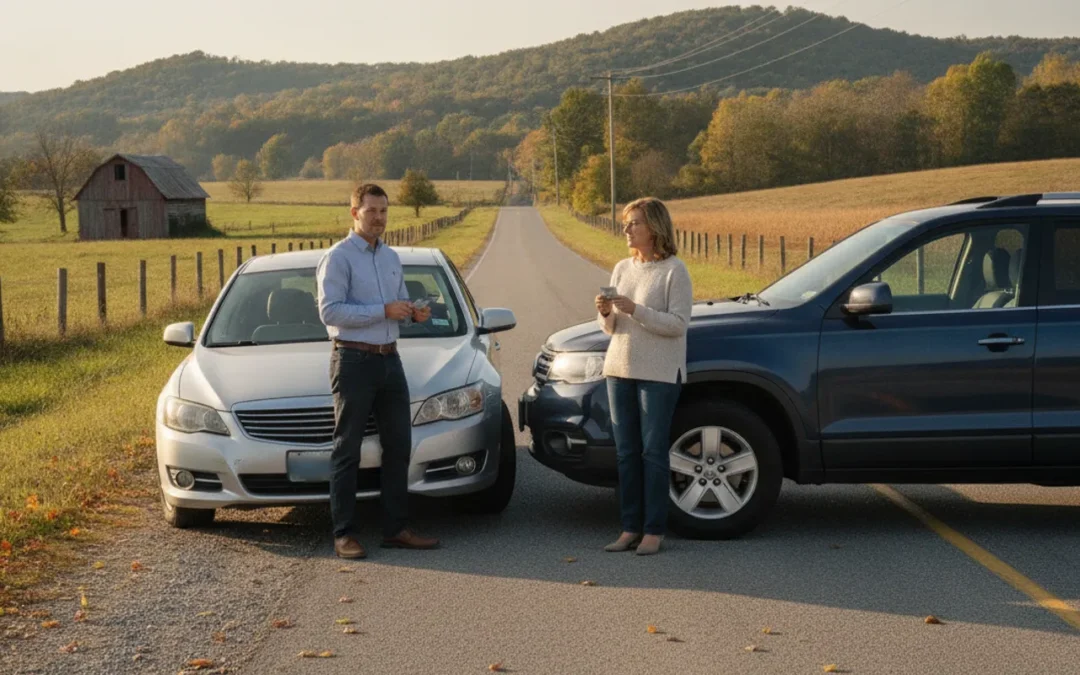
After a crash, it is natural to ask who may be legally responsible. Car crash liability in Kentucky depends on what happened, what each person did, and how reliable evidence supports the account. More than one person or organization may be involved, and an early insurance decision is not always the final word.
Request a free case evaluation
What does liability mean after a car crash?
Liability is legal responsibility for harm. In a car accident claim, the question is usually whether someone failed to use reasonable care and whether that conduct contributed to the crash and a person’s injuries or losses. A driver may be responsible for a careless act, such as failing to yield or following too closely, but the details matter. A collision alone does not answer who was at fault.
It also helps to separate three questions that people often combine:
- What caused the collision? The events and decisions leading up to impact.
- Who may be legally responsible? One or more people or entities whose conduct may have contributed.
- What insurance may apply? The available policies and coverage, which can involve different questions from who caused the crash.
An insurer may give an initial view based on the information it has. That view is not necessarily a complete investigation. A useful starting point is to write down what you remember and preserve records before details fade. For immediate post-crash steps, see this guide to what to do after a car wreck.
These questions may take time to answer. For example, a driver may remember seeing a green light, while another account describes a late turn. A photo taken after the vehicles moved may not show where they were at impact. Instead of treating one detail as conclusive, consider how accounts, physical evidence, and records fit together. That approach can help separate what is known from what still needs to be checked.
Who may be responsible for a Kentucky crash?
The other driver is often the first person considered, but a careful review may look beyond the driver. The answer depends on the facts and on whether there is evidence connecting a person or organization’s conduct to the crash and the resulting harm.
| Person or entity | Why they may be considered | What information may matter |
|---|---|---|
| A driver | A driving decision or failure to act may have contributed to the collision. | Scene evidence, witness accounts, vehicle damage, video, and available crash records. |
| A vehicle owner | The owner’s role, permission to use the vehicle, or other facts may raise questions about responsibility. | Who owned the vehicle, who was driving, whether use was allowed, and the circumstances of that use. |
| An employer or business | A driver may have been working or carrying out a business task when the crash happened. | Work schedules, trip purpose, employer records, and the driver’s relationship to the business. |
| Another potentially responsible party | A separate act or condition may have contributed to how the crash occurred. | Specific evidence about the condition, conduct, timing, and connection to the collision. |
This table identifies questions to investigate, not a determination that any listed person is liable. For example, the fact that a car belongs to someone else does not by itself settle the owner’s responsibility. Likewise, a driver’s use of a vehicle for work does not automatically establish that the employer is responsible. Permission, purpose, relationships, and other case-specific facts may matter. Avoid assuming that a name on a registration, insurance card, or work uniform resolves the issue.
A useful way to sort out the possibilities is to build a short timeline. Note who was driving, where the trip began and was headed, what the driver was doing just before impact, and what happened immediately afterward. Then list the records that might confirm or challenge each point. A delivery schedule, for example, could help establish a work-related trip, but it would not by itself show how the collision occurred or prove that a business is legally responsible.
How can more than one person share fault?
Sometimes the evidence suggests that more than one person’s conduct contributed to a crash. Kentucky follows a comparative-fault approach: responsibility may be divided among parties based on their share of fault, and a claimant’s own share can affect the amount of damages that may be recovered. The specific allocation depends on the evidence and legal analysis. It is not always as simple as one driver being completely right and the other completely wrong.
For instance, one driver may have entered an intersection when it was not safe, while another driver may have been moving too fast to stop. Those facts would need to be examined rather than presumed. The point is not that either driver automatically bears a particular share. It is that a careful review may consider each person’s actions and how they relate to the collision.
In practical terms, an account that identifies a possible mistake does not automatically settle the entire claim. The timing, visibility, distance, and actions of each person may still matter. A witness might confirm that one vehicle entered the intersection first, while a signal record or video could clarify the light sequence. Evidence may support, narrow, or contradict an initial description. Avoid trying to calculate a percentage from a single detail; responsibility depends on the full record and the applicable law.
Statements made in the stressful moments after a crash may not capture the full picture. If an adjuster says you share fault, ask what evidence supports that view and keep a record of the conversation. For a more focused discussion of how shared responsibility can affect a claim, read how shared fault may affect a Kentucky car accident claim.
What evidence can help explain who was responsible?
Liability is assessed from the available facts, so preserve information that may help explain the sequence of events. Evidence can support one account, raise new questions, or show that the first account was incomplete. Do not put yourself at risk to collect it, and do not alter or delete records.
- Photos and video: If it is safe, photograph vehicle positions, damage, the roadway, signs, signals, debris, and visible conditions. Keep original files when possible.
- Witness details: Write down names and contact information for people who saw the crash. If a witness is willing, note what they observed in their own words.
- Crash and insurance records: Keep the crash report information, claim numbers, letters, and messages. Ask how to obtain a report if one was made.
- Medical records and symptom notes: Follow medical advice and keep appointment information and records of how injuries affect daily activities.
- Repair and expense records: Save estimates, invoices, towing receipts, and records of other crash-related expenses.
- Vehicle and electronic information: Depending on the situation, vehicle damage, onboard data, or available camera footage may help clarify timing or movement. It may not be available in every case.
When saving digital material, keep the original photo or video file if possible, rather than relying only on a cropped or edited copy. Make a note of when and where it was taken. Keep messages in their original form and record the name of anyone who sent a relevant file. If a nearby business may have video, write down its location and the approximate time window; ask about preserving it without trespassing or demanding access. Footage may be overwritten, so early documentation of where it may exist can be useful.
Evidence can disappear. Nearby businesses may overwrite camera footage, vehicles may be repaired, and people may forget what they saw. Make a dated note of what evidence exists and where it may be. Do not trespass, confront another driver, or attempt to access someone else’s device or vehicle. An investigator-backed review can help organize available information; Rick Hessig is both a licensed attorney and a Licensed Professional Private Investigator. That fact does not mean every type of evidence will exist or determine the outcome.
For practical reporting and documentation steps, see how to report a car accident and this car accident checklist.
What if the other driver was working or using someone else’s car?
When a driver was using a vehicle owned by another person, the driver and owner may raise separate questions. Find out who had the keys, whether the driver had permission, and what the vehicle was being used for. Do not treat ownership alone as proof of liability or as proof that the owner has no responsibility.
If the driver was on a work-related trip, useful facts may include who directed the trip, whether it was part of the person’s job, and whether the person was acting for a business at the time. A company name on a vehicle or the driver’s employment by itself may not answer whether the employer can be held responsible. The circumstances of the trip and the applicable law matter.
Records that may help clarify the trip can include a dispatch message, work schedule, delivery instruction, or the driver’s own account of the purpose. Preserve only material you have lawful access to. Do not contact an employer in a confrontational way or assume that a uniform or company logo answers the legal question. The goal is to identify the relevant facts and let the evidence show whether the trip was connected to work.
These questions can also affect which insurance policies should be identified. Keep copies of any insurance information you receive, but do not assume that one policy is the only one that could apply. If you are dealing with an uninsured or underinsured driver, this overview of an uninsured-driver claim in Kentucky may help you identify questions to ask.
How should you handle an insurer’s view of fault?
Give accurate information, but do not guess when you do not know an answer. You can say you are unsure rather than fill gaps with assumptions. Keep a note of the date, the person you spoke with, and what was discussed. If you are asked to provide a recorded statement or sign a document, understand what is being requested before you agree.
Do not post speculation about the crash or your injuries online. Avoid making assumptions about fault in a text or social media post. Preserve messages and documents rather than deleting them. If the insurer disputes fault, ask for the basis of its position and consider whether relevant evidence has been collected.
You can organize an insurance conversation with a few simple questions: What facts is the adjuster relying on? Are there photographs, witness accounts, or records that have not yet been reviewed? Is the insurer asking for a statement, authorization, or release, and what does that document cover? Keep copies of what you send and receive. If you do not understand a request or disagree with a description, take time to clarify it rather than agreeing just to end the call.
Liability and the value or handling of an injury claim are related, but they are not identical. The nature of the injuries, medical care, expenses, and how the event affects a person’s life may also be important. For a broader overview of insurance communications, read how to handle an auto insurance claim after a Kentucky crash.
What should you do next after a Kentucky crash?
- Take care of immediate safety and health. Call for emergency help when needed and follow medical guidance. Seek medical attention immediately for your injuries.
- Record what you remember. As soon as you can, make a factual timeline, including direction of travel, traffic signals, weather, and what happened before and after impact.
- Preserve evidence. Save photographs, messages, receipts, and claim correspondence. Make a list of possible witnesses and locations where video may exist.
- Keep insurer communications organized. Note calls and deadlines mentioned by an insurer. Avoid guessing or agreeing to a description you believe is inaccurate.
- Ask questions before making a decision. If the facts are disputed, injuries are significant, or more than one person or policy may be involved, a legal review can help clarify the issues and possible next steps.
A practical file can be simple: create one folder for photographs and records, one note with the timeline and witnesses, and one list of calls and claim numbers. Add the date to each new note. If someone in your family is helping, agree on one place to keep copies so documents are not scattered across text messages and email. This does not decide the liability question, but it makes it easier to explain the situation consistently and spot missing information.
For Kentucky crash victims, the Kentucky State Police’s 2024 crash facts report records 707 people killed in 663 fatal traffic collisions on Kentucky roadways. That statewide figure does not determine responsibility in an individual crash, but it is a reminder that crashes can have serious consequences and that each situation deserves attention to its own facts.
Rick Hessig Law serves car-accident victims in Louisville and the Kentuckiana area. A free case evaluation can provide an opportunity to discuss the circumstances, available information, and questions about the next step. The firm describes its fee arrangement as “No Fee Unless You Win,” with no upfront attorney fee; case and court costs may be the client’s responsibility in accordance with KBA regulations. The details of any representation and costs should be discussed directly.
Learn more about when filing a Kentucky car accident lawsuit may be a next step, or review what can affect car accident settlement expectations. Neither outcome nor recovery can be promised in advance.
Start a free, no-obligation case evaluation
Frequently asked questions
Can someone other than the other driver be liable?
Possibly. Depending on the facts, an owner, employer, or another party may warrant review. Their involvement does not automatically establish liability; the evidence and applicable law matter.
Can I still have a claim if I may share some fault?
Possibly. Kentucky uses comparative fault, so a person’s share of responsibility may affect recovery. The facts and the allocation of fault need to be evaluated in the specific case.
Does the police report decide who is legally responsible?
A crash report may contain useful information, but it is one source of evidence. It does not necessarily answer every question about legal responsibility or resolve a disputed insurance claim.
What if I do not know who saw the crash?
Write down any details you remember about people or nearby businesses that may have had a view of the scene. Save your own photos and records, and avoid trying to obtain footage without permission.
Talk through your next step
If you were injured in a Kentucky crash and do not know who may be responsible, you do not have to sort through every issue alone. Gather what you can, avoid guessing about disputed facts, and ask for a clear explanation of the options available to you.